
Should You Run Your AC and Ceiling Fan Together? Here's What It Does to Your Bill
Yes, running your ceiling fan and air conditioner at the same time can lower your cooling bill, but only if you use the fan to raise your thermostat setting. A ceiling fan doesn't actually cool a room; it creates a wind-chill effect that makes you feel up to 4°F cooler, according to the U.S. Department of Energy.
That means a Cincinnati or Northern Kentucky homeowner who bumps the thermostat from 74°F to 78°F while running a fan can stay just as comfortable while cutting compressor run-time, and with Duke Energy bills up sharply this summer, that difference shows up fast. Run a fan without adjusting the thermostat, though, and you're just adding a second appliance to your electric bill for no benefit.
Does Running a Ceiling Fan While the AC Is On Actually Lower Your Energy Bill?
Only indirectly, and only if you raise the thermostat. A ceiling fan motor draws somewhere between 15 and 100 watts, compared to the 2,000 to 5,000 watts a central air conditioner's compressor pulls when it's running. The fan itself barely registers on your electric bill. The real savings come from what the fan lets you do to your thermostat.
Field research from the Florida Solar Energy Center found that pairing a ceiling fan with a 2°F thermostat increase produced roughly 14% net savings in annual cooling costs, after accounting for the fan's own electricity use.
But that same study found something homeowners in Cincinnati and Northern Kentucky should take seriously: when people ran fans without ever touching the thermostat, their air conditioning use didn't drop at all, and in some cases their total energy costs went up because the fan was just running for free in an empty room. The fan is only a savings tool if it changes your behavior at the thermostat.
How Does a Ceiling Fan Make a Room Feel Cooler Without Changing the Temperature?
Your body cools itself by evaporating sweat off your skin. Moving air speeds up that evaporation, which is the same principle behind a wind-chill reading on a winter weather forecast. ENERGY STAR's guidance on ceiling fans notes that a well-placed fan can make a room feel as much as 8°F cooler to the people standing under it, even though a thermometer on the wall would show no change at all.
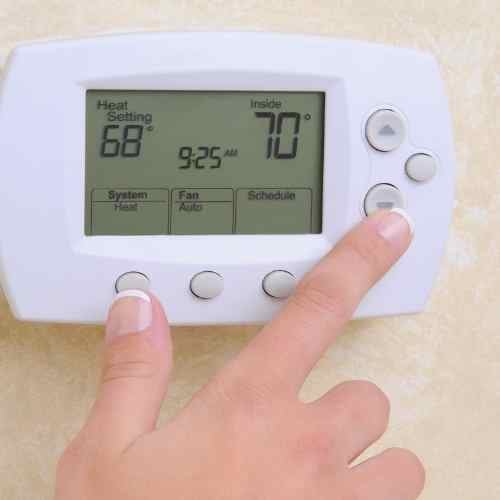
That's an important distinction for smart thermostat owners: because the fan cools you, not the room, your thermostat sensor never "feels" the fan. It keeps calling for cooling based on the actual air temperature, which is exactly why you have to manually raise the setpoint to capture any savings.
How Many Degrees Can You Raise Your Thermostat When Using a Ceiling Fan?
The Department of Energy's standard guidance is about 4°F with no loss in comfort, and most HVAC-efficiency researchers land in the same range. Wirecutter's review of ceiling fan and AC pairing cites data showing that for every degree above 75°F you raise the thermostat, you save roughly 3% on cooling energy.
So if you normally cool your home to 75°F, running a ceiling fan and bumping the setpoint to 79°F could trim your cooling costs by around 12%, for the cost of a few cents a day in fan electricity.
If you already use a smart or programmable thermostat, this is easy to build into your schedule: set a slightly higher cooling target for rooms where fans run regularly, like bedrooms and living areas, and let the thermostat handle the adjustment automatically.
How Much Could Cincinnati and Northern Kentucky Homeowners Save by Combining AC and Ceiling Fans?
This is where the local numbers matter. The average Duke Energy Ohio residential bill hit $115.56 in May 2026, up 66% from the year before, and Duke Energy Kentucky's average bill is running near $137 a month after a recent rate increase.
On a typical summer bill in that range, a 12-15% reduction in cooling costs from combining fans with a higher thermostat setting works out to real monthly savings, not just a rounding error.
Duke Energy's own local guidance for Cincinnati and Northern Kentucky customers specifically recommends operating ceiling fans in a counterclockwise direction during summer months as one of the primary ways to keep cooling costs in check, alongside closing blinds during the day and setting the thermostat to the highest comfortable temperature.
In our humid Ohio Valley summers, where the AC is often running most of the day from June through September, that adds up over a full cooling season more than it would in a milder, drier climate.

What Direction Should Your Ceiling Fan Spin in Summer?
Counterclockwise, when you're looking up at the fan from below the blades. Set the fan to its highest comfortable speed in summer; this direction pushes air straight down in a column, creating the strongest wind-chill effect.
In winter, flip the direction switch on the fan's motor housing so the blades turn clockwise at low speed. This pulls cool air up and gently redistributes warm air that collects near the ceiling, which is especially useful in Cincinnati-area homes with vaulted or high ceilings where heat stratification is common.
If you're not sure which way your fan is currently spinning, stand under it while it's running. If you feel a direct breeze, it's in summer mode. If you don't feel much airflow at all, it's likely set for winter.
When Does Running a Ceiling Fan With the AC Waste Money Instead of Saving It?
There are three common ways homeowners lose money on this combination:
- Leaving fans running in empty rooms. A ceiling fan cools people, not spaces. If no one is in the room, the fan is just consuming electricity for no comfort benefit.
- Never adjusting the thermostat. If you run the fan but keep the AC at the same setting you always use, you get the fan's electricity cost without any offsetting AC savings.
- Running the AC fan setting on "on" instead of "auto." Some Cincinnati homeowners leave their HVAC blower fan running continuously rather than cycling with the compressor, which Duke Energy notes can add roughly $25 a month to a summer bill compared to keeping it on auto.
Do Ceiling Fans Work Well With Every Type of AC System?
Ceiling fans pair well with central air, ductless mini-splits, and window units alike, since the underlying mechanism is the same: it's about the people in the room, not the equipment cooling it. Homeowners who've added a ductless mini-split system in a Cincinnati or Northern Kentucky home often find ceiling fans especially useful for evening out comfort in rooms the mini-split doesn't directly serve.
One nuance worth knowing: a ceiling fan only helps in the specific room where it's installed. If your thermostat is in the hallway and your fans are in the bedrooms, the fan won't influence what the thermostat reads, so you'll need to manually set the temperature higher to capture the savings rather than relying on the fan to trigger it automatically.
You may also be weighing a ceiling fan against a whole-house fan, which is a different piece of equipment that pulls outside air through the house and exhausts it through the attic. We cover how that compares to running AC in our post on whether you should run a whole-house fan and air conditioning together.

What Else Can Cincinnati Homeowners Do to Maximize AC and Fan Savings?
Ceiling fans are one piece of a bigger efficiency picture. A few habits compound the savings:
- Close blinds and curtains during the day to keep direct sun from adding to your cooling load.
- Check your air filter monthly during peak season. A dirty filter forces your AC to work harder, which erases some of the savings a fan and thermostat adjustment would otherwise deliver. Our guide on how often to change your AC filter covers the specifics for our climate.
- Keep up with annual AC maintenance. A properly serviced system runs more efficiently at any thermostat setting. See our guide on how often you should have your AC serviced for a Cincinnati-specific schedule.
- Run heat-generating appliances like the oven, dryer, or dishwasher during cooler morning or evening hours so your AC isn't fighting extra heat load during the hottest part of the day.
If your system is struggling to keep up even with fans running and the thermostat set reasonably, that's often a sign of a maintenance issue, an aging unit, or a sizing problem rather than something a fan can fix.
The Geiler Company has served Cincinnati, Northern Kentucky, and Southeastern Indiana since 1885, and our residential AC service team can diagnose whether your system is running as efficiently as it should be.
Frequently Asked Questions
Sources: U.S. Department of Energy, ENERGY STAR, Florida Solar Energy Center, NYT Wirecutter, Duke Energy, FOX19 Cincinnati, Cincinnati.com, Kentucky.com